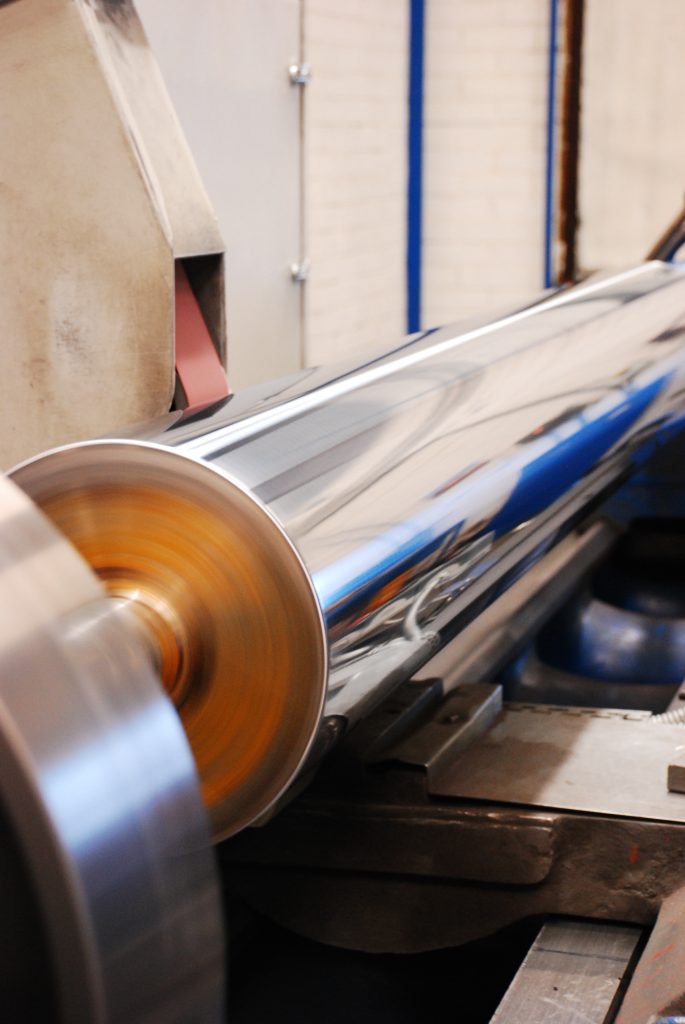
At Lomma Hårdkrom, we have extensive experience in hard chrome plating, and together with our modern chrome baths, we ensure that your steel components have improved functionality and service life.
Thanks to its high strength, steel is one of the most widely used materials in industrial components. Hard chrome plating gives steel parts a durable, corrosion-resistant surface that both protects against wear and reduces friction. This allows components to retain their precise dimensions for longer and be used under high loads in harsh production environments.
Steel components are often exposed to mechanical wear, high pressure, and continuous friction against other materials. Without surface treatment, this can lead to rapid contamination, corrosion, and reduced precision. Hard chrome plating gives the steel a hard, metallic chrome layer.
Hard chrome plating is therefore not just an aesthetic treatment, but a technical solution that improves the function and durability of steel in industry.
Do you have newly manufactured components that need durable surfaces? We help you from start to finished product. We have extensive experience of delivering hard chrome plating to customers in:
Hard chrome plating of steel with LOmma Hard Chrome
Before applying hard chrome, steel parts must be carefully prepared. Dirt, grease, and oxides are removed, and the surface may be polished or pretreated with metal layers such as nickel to ensure optimal adhesion.
When the part is immersed in a chrome bath, electroplating is performed using direct current. The steel acts as the cathode, while the anode consists of a suitable metal. Positively charged chrome ions in the solution attach to the surface of the part and form a dense, hard layer.
After plating, the part is rinsed and can be ground or polished depending on the surface finish and tolerance requirements. The result is a durable and corrosion-resistant surface, ready for demanding industrial environments.
At Lomma Hårdkrom, we have customized chrome baths for different sizes and geometries, making us a flexible partner for both new production and renovation of steel components.
With this capacity, we can ensure uniform hard chrome plating on all types of steel parts, from small machine parts to large industrial components. Through our combination of extensive experience and modern equipment, we deliver high precision, optimal surface finish, and long durability.
Do you need hard chrome plating on steel that can withstand high loads and provide a long service life? Contact us at Lomma Hårdkrom and we will tell you more about how our capacity and technical solutions can be adapted to your needs. We will help you extend the service life and improve the performance of your steel components.

Good to know about hard chrome plating of steel
When hard chromium plating steel, the chromium layer can be built up from a few micrometers to hundreds of micrometers, depending on the application. When renovating worn parts, a thicker layer of hard chromium is often used to restore the original dimensions.
Yes. Hard chrome plating is a common method for repairing worn shafts, cylinders, and sliding surfaces in steel. By first removing the damaged surface and then applying hard chrome, the dimensions and function of the part can be restored. This is often more cost-effective than manufacturing a completely new part, especially for larger industrial components.
Hard chrome plating is a technical surface treatment with a focus on wear resistance, low friction, and functional performance. Decorative chrome is mainly used for aesthetic purposes and has significantly thinner layers. In hard chrome plating of steel, the layer is thicker and adapted to withstand mechanical stress in industrial environments.
The hard chrome layer itself does not affect the basic strength of the steel, but the process must be carried out correctly to avoid hydrogen-induced embrittlement in certain types of steel. If necessary, de-embrittlement treatment is carried out after hard chrome plating to ensure that the mechanical properties of the steel are maintained.
The service life depends on the load, operating environment, and maintenance. In many industrial applications, hard chrome plating of steel can significantly extend the service life of the component compared to untreated material. With the right dimensions and correctly applied hard chrome coating, wear can be significantly reduced over time.
In highly corrosive environments, it may be worthwhile to perform hard chrome plating of stainless steel to give the parts improved surface properties against friction and wear.
Yes. After hard chrome plating, the surface can be ground or polished to achieve the exact surface finish and tolerance. This is particularly important for components that work with seals, bearings, or sliding surfaces where surface roughness affects function and service life.
Good to know about hard chrome plating
Hard chromium plating is an electrolytic surface treatment where a hard chromium layer, normally
around 20-100 µm, is applied to a metal component. The treatment is used to give
the surface very high wear resistance, low friction and improved corrosion protection in demanding environments.
A hard chrome-plated surface has several important properties:
Hard chrome plating is a good choice when components are subject to high wear, high loads, high temperatures or harsh chemical influences. It is also suitable when you need to combine a strong base material with a highly wear-resistant surface, or when you want to build on material to restore exact dimensions.
YES Hard chrome plating is often used for refurbishment and repair work on worn or damaged parts. By grinding, hard chrome plating and then finishing the surface, components can be restored to the correct dimensions and have an extended service life.
We have one of Scandinavia's most well-equipped facilities for hard chrome plating with three large chrome tanks and lifting capacity up to 10 tons in both pre-treatment and chrome plating. Examples of dimensions we can treat are:
Hard chrome plating is used in several types of heavy industry, for example:
What they have in common is that the components work in demanding environments where high wear resistance and reliability are crucial.
The main advantages of hard chrome plating are the combination of high hardness, long life
and low friction. It provides: