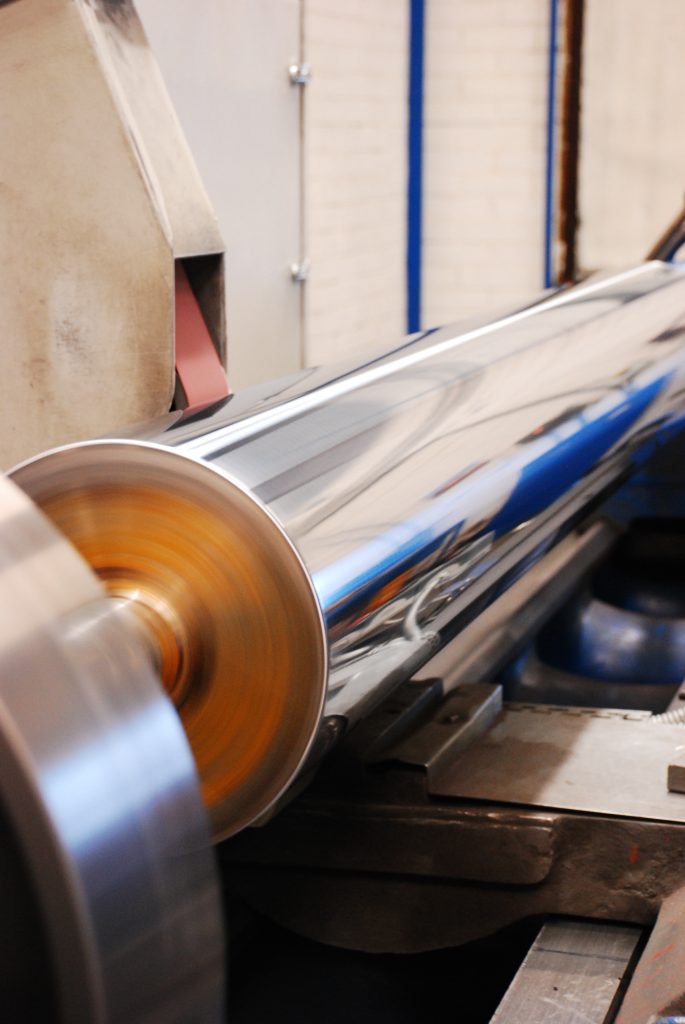
When you choose to hard chrome plate your parts with us at Lomma Hårdkrom, you get several benefits, such as reduced friction and increased service life.
Stainless steel is often used where both strength and corrosion resistance are crucial, for example in food production, the chemical industry, and machine components exposed to moisture and chemicals. Hard chrome plating gives stainless steel a hard, even surface that protects against mechanical wear and extends the service life of the component.
Despite its natural corrosion protection, stainless steel can wear down when subjected to high friction, heavy loads, or contact with aggressive materials. Hard chrome plating gives the surface a metallic chrome layer between 20 and 100 micrometers thick, providing extra protection and improved functionality.
This makes hard chrome plating an excellent solution when stainless steel needs to perform in demanding environments without compromising its corrosion resistance.
Do you have newly manufactured components that need durable surfaces? We help you from start to finished product. We have extensive experience of delivering hard chrome plating to customers in:
We can help you with hard chrome plating
To achieve optimal adhesion and an even surface, the stainless steel part is carefully pretreated. The surface is cleaned of dirt, grease, and oxides, and can be sanded or coated with a metal layer such as nickel before electrolytic chromium plating begins.
During hard chrome plating, the part is placed in a chrome bath with an electrolytic solution, where it acts as a cathode. The anode consists of a suitable metal, and when current is passed through the bath, the chrome ions attach to the surface of the part. The result is a hard, durable, and corrosion-resistant layer. Our hard chrome plating gives you a surface that reaches 65-69 HRC for very strong protection.
After plating, the parts can be polished or ground to achieve the desired surface finish and tolerance. For stainless steel, it is particularly important to maintain the corrosion resistance and hygienic properties of the surface layer, which is possible with hard chrome plating.
Our specially adapted chrome baths can handle stainless steel parts in various sizes and shapes.
Thanks to our modern chrome baths, we can handle all kinds of stainless steel parts, regardless of size or shape.
Do you need hard chrome plating on stainless steel that can withstand high wear and tear and maintain corrosion protection? Contact us at Lomma Hårdkrom for expert advice and solutions that improve the functionality and extend the service life of your stainless steel components.

Good to know about hard chrome plating of stainless steel
Stainless steel has a natural passive oxide layer that provides corrosion resistance. In hard chrome plating, the surface is covered with a technical chrome layer, which means that the original passive surface is replaced by a new functional coating. It is therefore important that the process is carried out in a controlled manner so that corrosion resistance is not impaired in transition zones or uncoated areas.
Stainless steel has good corrosion resistance in itself, but in applications with high friction, repeated contact, or abrasive wear, material selection alone may be insufficient.
Austenitic, ferritic, and martensitic stainless steels can be hard chrome plated, but the alloy composition affects how the surface reacts during surface treatment. High levels of chromium and nickel may require special activation of the surface prior to hard chrome plating to ensure uniform build-up and good adhesion. In some designs, it may also be appropriate to choose a different base material and instead work with hard chrome plating of steel.
When hard chrome plating is done correctly, the surface can retain its hygienic properties, which is important in industries such as food and pharmaceuticals. Decisive factors are surface finish, pore structure, and post-processing, as these affect how easy it is to clean surfaces and the risk of bacterial accumulation.
When different metals are combined in humid environments, galvanic corrosion can occur. A hard chrome coating on stainless steel means that the surface has a different electrochemical potential than the base material. In designs that include multiple metals, this should be taken into account in the technical assessment to avoid unwanted corrosion effects.
Hard chrome works well in many industrial temperature ranges, but very high operating temperatures can affect both the structure and adhesion of the chrome layer. The mechanical properties of hard chrome plating are retained up to temperatures between 400 and 450°C, after which the chrome layer loses its hardness and resistance. At temperatures above 600°C, thermally induced cracking may occur.
Austenitic stainless steel is normally non-magnetic, while some other stainless grades may be slightly magnetic. The hard chrome layer itself is not magnetic, but the underlying steel grade determines how the component behaves in magnetic environments. Hard chrome plating does not change the basic structure of the material.

Good to know about hard chrome plating
Hard chromium plating is an electrolytic surface treatment where a hard chromium layer, normally
around 20-100 µm, is applied to a metal component. The treatment is used to give
the surface very high wear resistance, low friction and improved corrosion protection in demanding environments.
A hard chrome-plated surface has several important properties:
Hard chrome plating is a good choice when components are subject to high wear, high loads, high temperatures or harsh chemical influences. It is also suitable when you need to combine a strong base material with a highly wear-resistant surface, or when you want to build on material to restore exact dimensions.
YES Hard chrome plating is often used for refurbishment and repair work on worn or damaged parts. By grinding, hard chrome plating and then finishing the surface, components can be restored to the correct dimensions and have an extended service life.
We have one of Scandinavia's most well-equipped facilities for hard chrome plating with three large chrome tanks and lifting capacity up to 10 tons in both pre-treatment and chrome plating. Examples of dimensions we can treat are:
Hard chrome plating is used in several types of heavy industry, for example:
What they have in common is that the components work in demanding environments where high wear resistance and reliability are crucial.
The main advantages of hard chrome plating are the combination of high hardness, long life
and low friction. It provides: